Condors, guanacos, vizcachas, pumas and more. The Andes of San Juan are an incredible refuge for high-altitude wildlife — and horseback travel lets you get closer than any vehicle ever could.
One of the most extraordinary aspects of the Andes Horseback Expedition is the wildlife you encounter in its natural habitat at extreme altitude. Because we travel on horseback rather than in vehicles, and because we camp in the heart of the Cordillera for multiple nights, we experience animals that most people never get close to.
Horses are not perceived as threats by Andean wildlife. A vehicle causes animals to flee. A group on horseback moves quietly through the landscape and animals — particularly guanacos and condors — often approach out of curiosity.
THE ANDEAN CONDOR
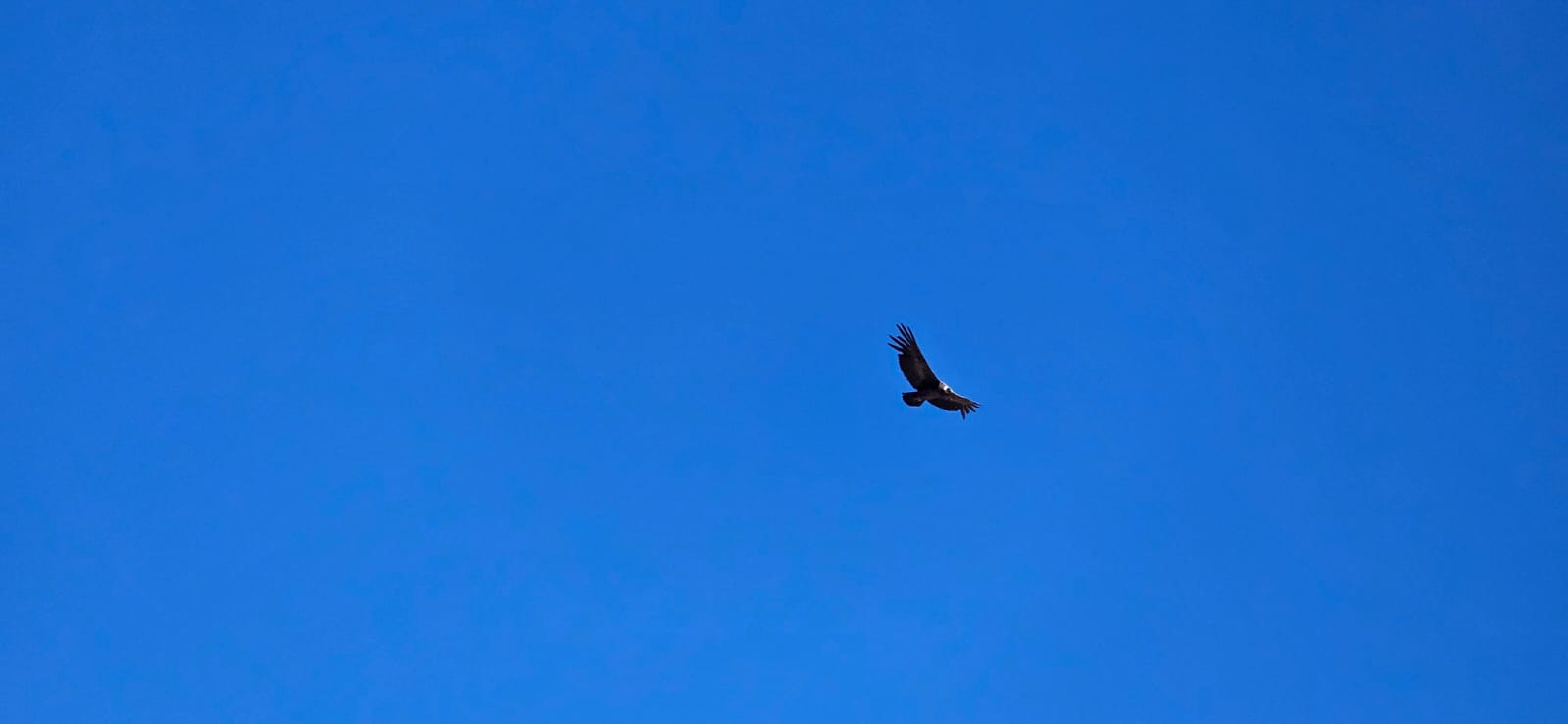
The undisputed symbol of the Andes. Wingspan up to 3.2 meters — the largest flying bird in the world by combined weight and wingspan. You will almost certainly see condors riding thermal updrafts near the Espinacito Pass on Day 3. They are naturally curious about the horses and will often circle the group closely, sometimes within 20 meters.
The condor can live to 70 years and mates for life. A pair will raise only one chick every two years. In the Huarpe cosmology of the San Juan people, the condor is the messenger between the living world and the spirit world — a significance our cultural interpreters explain at the summit of the Espinacito.
GUANACOS
South America's wild camelid — the ancestor of the domesticated llama. Guanacos live in family groups of 5 to 20 animals and are extremely common throughout the Andean valleys we traverse. On Days 4 and 5, you will ride past herds of 50 or more individuals grazing the high-altitude meadows of Valle Hermoso.
They are not afraid of horses, making close observation easy and natural. Their eyes — enormous and fringed with long lashes — are extraordinary. Young guanacos (chulencos) are born in the spring and can be seen in the valleys on early-season departures.
VIZCACHAS
These large Andean rodents look like a cross between a rabbit and a chinchilla, with long bushy tails and enormous ears. They live in rock formations (vizcacheras) and are most active at dawn and dusk. You will find them on the rocky slopes of the Espinacito and in the boulder fields along the route — often sitting completely still, relying on camouflage rather than flight.
They are remarkably tame around horses and will allow approach within a few meters. Children and first-time visitors invariably love them.
PUMAS
Present throughout the area but extremely difficult to see — they are crepuscular and expert at concealment. However, our baqueanos regularly find fresh puma tracks near the camps, particularly in the soft soil near water sources. The presence of pumas is a sign of a healthy ecosystem in perfect balance.
ANDEAN FOXES (CULPEOS)
These medium-sized foxes are regularly seen near the camps, especially at dusk and after dinner. They are somewhat bold and will approach within 10 to 15 meters, curious about the fires and the smell of cooking. They pose no threat and make for remarkable photography in the evening light.
BIRDS OF PREY
Beyond condors, you will encounter Andean eagles (águila mora) with wingspans approaching 2 meters, various falcons, red-backed hawks, and the mountain caracara — a striking black-and-white raptor that follows the group along ridgelines.
THE NIGHT SKY
Not an animal, but alive. At 3,500 to 4,500 meters above sea level, with zero light pollution for hundreds of kilometers in every direction, the night sky of the Andes is one of the clearest on Earth. The Milky Way appears as a solid, textured band of light. The Southern Cross, the Magellanic Clouds, and the great nebulae of the southern sky are visible with the naked eye.
Many riders describe lying outside their tents after dinner, looking up at a sky they had never seen before, as the most memorable single moment of the entire expedition.