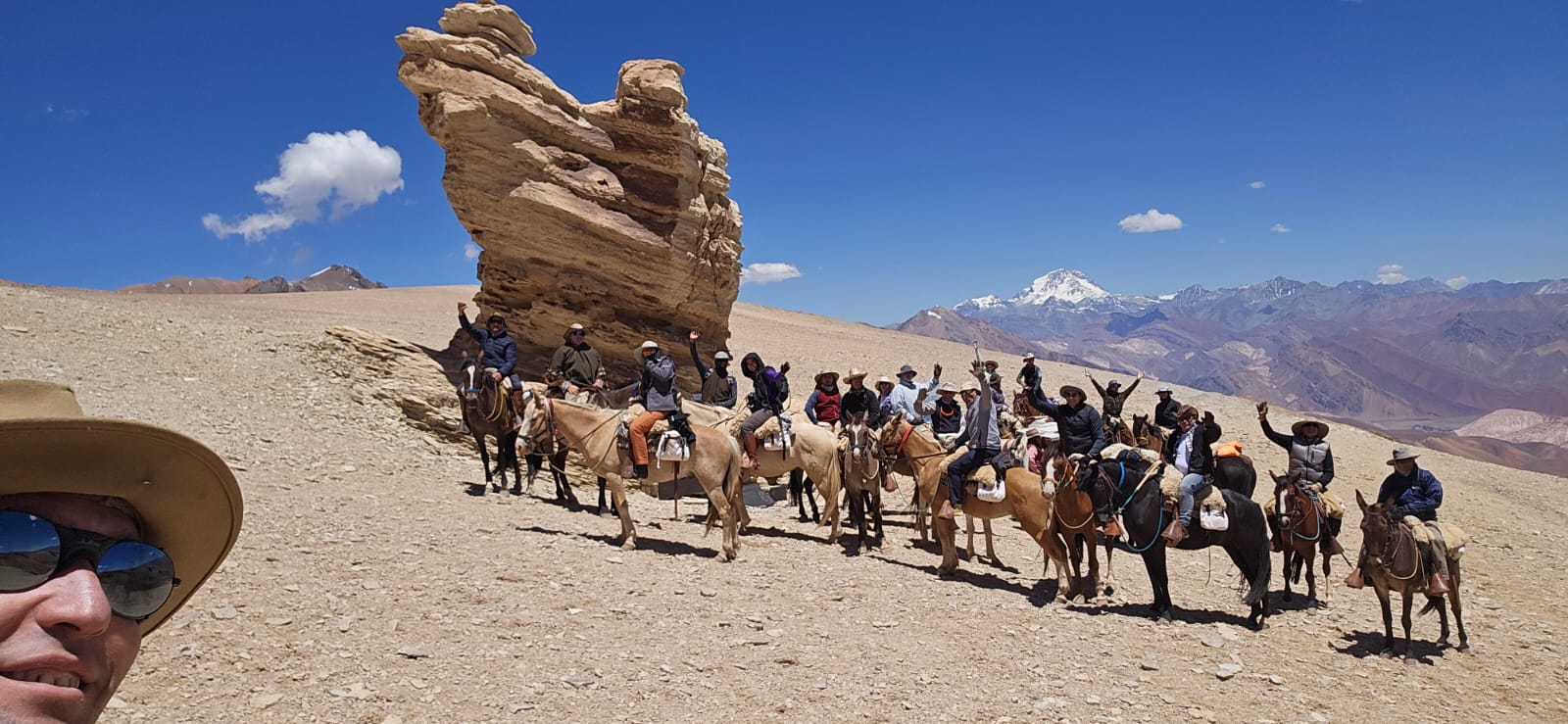
In 1817, General San Martín led one of the most audacious military crossings in history. Today, you can relive that epic feat on horseback through the same mountain passes.
In January 1817, General José de San Martín and his Army of the Andes crossed the Cordillera from Argentina into Chile, executing one of the most ambitious military operations in South American history. Our expedition follows the exact route of the main column through the San Juan Andes.
THE STRATEGY
San Martín organized his force into six columns crossing at different passes simultaneously — creating confusion for the Spanish royalists while ensuring that at least some columns would succeed. The main column, which our expedition follows, passed through the San Juan Andes via the Espinacito Pass at 4,500 meters above sea level.
The total force numbered approximately 5,400 men, 10,600 mules and 1,600 horses. Logistics for this crossing were planned over two years — it was not a spontaneous campaign but a meticulously engineered operation.
THE ROUTE WE FOLLOW
The Liberation Army departed from Mendoza and San Juan between January 12 and 18, 1817. Our expedition retraces the main column's route day by day:
Day 2 — The column departed from Barreal and headed toward Los Manantiales, just as we do today. The dirt roads through the Valle de Barreal have changed little in two centuries.
Day 3 — The crossing of the Espinacito Pass (4,500 m.a.s.l.) was the most grueling day of the campaign. Soldiers, horses, and artillery were hauled over the ridge. At the summit, our cultural interpreters recreate the scene — you stand exactly where those soldiers stood.
Day 5 — The International Border Landmark at Valle Hermoso Pass marks the farthest point of the expedition. In 1817, crossing this point meant entering royalist-controlled Chile. Today it marks the halfway point of our return journey.
THE BATTLE OF CHACABUCO
On February 12, 1817 — just weeks after completing the crossing — the combined forces of San Martín and Chilean patriot Bernardo O'Higgins defeated the royalist army at the Battle of Chacabuco, effectively liberating Chile.
The crossing of the Andes was the decisive first step in the liberation of South America from Spanish colonial rule. Within six years, virtually the entire continent would be independent.
WHY THIS MATTERS TODAY
When you reach the Peñón del Espinacito at 4,500 meters above sea level and look west toward Chile, you are standing exactly where those soldiers stood over 200 years ago. Our cultural interpreters bring this history to life at every campsite and mountain pass — connecting the physical landscape to the human story that unfolded here.
This is not just an adventure trip. It is a living history experience in one of the most dramatic natural settings on Earth.